
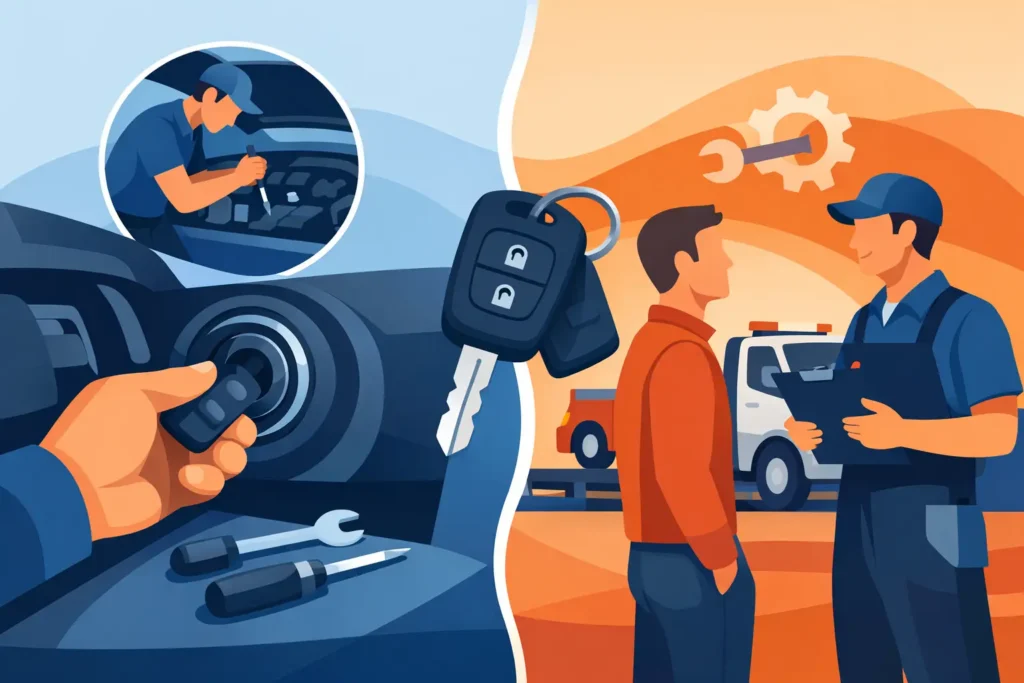
A key that suddenly will not turn can make a normal errand feel impossible. Before trying to force anything, car ignition repair at home should begin with a few careful checks. Some ignition problems have a simple cause, such as a locked steering wheel, weak key fob battery, or worn key. Others require professional tools, key cutting, or programming to avoid damaging the ignition further.
Start With the Symptom, Not the Ignition
“Ignition problem” can mean several different things. The key may not enter the cylinder, it may enter but not turn, it may turn without starting the vehicle, or the engine may start and immediately shut off. A push-button vehicle can have similar symptoms even though it does not use a traditional ignition cylinder.
The right solution depends on what the vehicle is doing. Replacing an ignition when the real issue is a dead battery or unrecognized transponder key wastes time and money. Pay attention to the dashboard lights, the feel of the key, and whether the vehicle responds at all.
If your vehicle has a traditional key, begin by confirming the key is fully inserted and not visibly bent, cracked, or heavily worn. Do not use pliers to twist it. A key can snap inside the ignition, turning a manageable service call into a broken-key extraction and ignition repair.
Safe Checks for Car Ignition Repair at Home
A few checks can resolve common no-start situations without taking apart the steering column. Work with the vehicle parked safely, transmission in Park or Neutral, and the parking brake set.
Release a Locked Steering Wheel
A steering wheel lock is one of the most common reasons a key will not turn. It often happens after you park with the wheels turned and remove the key. The wheel may move only slightly in one direction and feel firmly locked in the other.
Hold the steering wheel in the direction where it has a little movement, then gently turn the key at the same time. Use steady pressure, not force. When the tension comes off the locking mechanism, the key should turn normally. If it does not, stop rather than pushing harder.
Try a Properly Cut Spare Key
If you have a spare key, try it once. A worn original key may no longer lift the ignition wafers correctly, especially on older vehicles with high mileage. If the spare works, the issue may be the key rather than the ignition cylinder.
Avoid relying on a hardware-store copy for this test if possible. A duplicate made from an already worn key can carry over the same wear. An automotive locksmith can cut a new key to the vehicle’s correct key code when available, which can provide a more accurate fit than copying a damaged key.
Check Vehicle and Key Fob Power
If the key turns but the dashboard stays dark, the vehicle battery, battery connections, or main electrical system may be the issue. Turn on the headlights or interior lights to see whether the battery has enough power. Corroded or loose battery terminals can also create an intermittent no-start condition.
For push-button start vehicles, hold the key fob directly against the start button or place it in the backup recognition location identified in the owner’s manual. Many vehicles can read a fob with a weak battery at close range. If the vehicle starts this way, replacing the fob battery may solve the immediate problem.
Confirm the Vehicle Is in Park or Neutral
An automatic vehicle will not start unless it recognizes Park or Neutral. Press the brake pedal firmly, move the shifter to Neutral, and try starting again. If it starts in Neutral but not Park, the issue may involve the shift interlock or neutral safety switch rather than the ignition.
Manual-transmission vehicles may require the clutch pedal to be fully depressed. Floor mats, debris, or a pedal that is not fully returning can prevent the vehicle from recognizing the start command.
What Not to Do to a Stuck Ignition
The internet has plenty of shortcuts for a stuck key, but many create expensive damage. Do not drill the ignition, pry the steering column covers apart, or use a screwdriver in place of the key. Modern vehicles often have immobilizer components, delicate wiring, and security systems around the ignition area.
Avoid spraying heavy oil, household lubricant, or large amounts of penetrating fluid into the keyway. These products can collect dirt, interfere with the ignition’s internal parts, and make diagnosis harder. A professional may use the correct lock lubricant when appropriate, but lubrication will not repair worn wafers, a failed ignition housing, or a damaged key.
You should also avoid repeatedly cycling a key that is binding. If it breaks, the remaining piece can block the cylinder and may need to be extracted before a new key can be made or the ignition can be serviced.
When the Key Turns but the Car Will Not Start
A turning key only confirms that the mechanical portion of the ignition is moving. It does not confirm that the vehicle recognizes the key or that the starter circuit is working.
If the dash lights come on but the engine will not crank, listen for a click, rapid clicking, or no sound at all. A single click can point to a starter or electrical issue. Rapid clicking commonly suggests low battery power. No response can involve the battery, starter circuit, ignition switch, brake or clutch safety system, or a key recognition problem.
If the engine cranks but starts and then immediately stalls, an immobilizer issue may be involved. Most newer vehicles use a transponder chip, smart key, or programmed fob to authorize starting. A key blade can turn the ignition and still fail to start the engine if its chip is damaged, missing, or no longer programmed correctly.
This is where automotive locksmith equipment matters. We can diagnose many key-related no-start issues, cut replacement keys, and program compatible transponder keys, smart keys, and key fobs for many major American, Asian, and European vehicles.
Signs the Ignition Cylinder Needs Professional Service
A failing ignition cylinder usually gives warning signs before it stops working completely. You may need to jiggle the key, insert it at a certain angle, or try several times before it turns. The key may be difficult to remove, or it may turn farther than usual without activating accessories or the starter.
These symptoms can come from worn ignition wafers, a damaged key, a failed ignition switch behind the cylinder, or internal steering-column components. The correct repair depends on the vehicle and the specific failure. On some vehicles, a locksmith can repair or replace the ignition cylinder and prepare keys that work with the existing locks. On others, the best option may be replacing the ignition assembly and programming new keys.
A professional diagnosis helps avoid replacing parts that are still functional. It also helps preserve the convenience of having one key operate the ignition, doors, and trunk whenever the vehicle allows it.
Mobile Ignition Help Where the Car Is Parked
A vehicle with an ignition issue is often not drivable, which makes a mobile automotive locksmith a practical option. Instead of arranging a tow for a key or ignition-cylinder problem, you can have a qualified technician come to your home, workplace, parking lot, or roadside location.
Locksmith Squad provides mobile automotive locksmith service throughout Tampa Bay, including Brandon, Valrico, Tampa, Plant City, Lakeland, Clearwater, and St. Petersburg. We work with most major vehicle makes and can help with ignition repair and replacement, broken key extraction, lost car keys, spare keys, transponder programming, smart keys, and key fob replacement when the situation calls for it.
When you call or text, share the vehicle year, make, model, your location, and a clear description of the symptom. Let us know whether the key is stuck, broken, turning without starting, or completely missing, and whether you have any working keys. That information helps us check availability and provide a more useful estimate before service begins.
A Small Problem Is Easier to Fix Early
If your key has started sticking only occasionally, do not wait for it to fail in a grocery-store parking lot or outside your home after work. A new properly cut key or timely ignition service can often prevent a full lockout, a broken key, or an unnecessary tow. Treat the warning signs gently, keep a working spare when possible, and call a mobile automotive locksmith when the problem is beyond a safe basic check.