
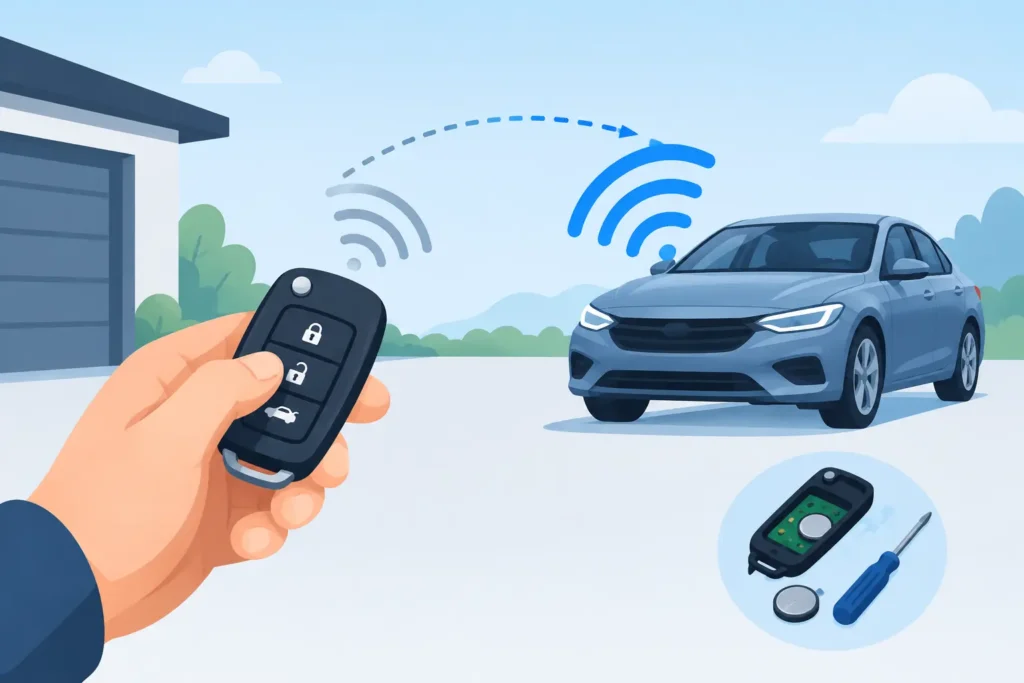
A remote that works only when you are standing next to the driver’s door is more than an annoyance. If you need to fix weak car remote performance, the cause may be as simple as a tired coin-cell battery, but it can also point to a damaged fob, interference, a vehicle-side receiver issue, or a key that needs professional attention.
The useful clue is consistency. Does the remote work poorly everywhere, or only at home or at work? Did the range suddenly drop after the fob was dropped, washed, or left in a hot vehicle? Answers to those questions help narrow down the next step without replacing parts that are still working.
Start With the Remote Battery
A weak battery is the most common reason for reduced key fob range. The remote may still lock and unlock the vehicle, but the signal becomes unreliable and requires you to move closer. On push-button-start vehicles, you may also see a “key not detected” message, intermittent starting trouble, or a warning about the key fob battery.
Use the exact battery type specified for your fob. Many remotes use common coin batteries, but the sizes are not interchangeable. Before opening the case, use the emergency key release or the small seam in the housing as intended. Prying in the wrong spot can crack the shell, damage the circuit board, or loosen the buttons.
Install the new battery with the correct positive and negative orientation, then test every function: lock, unlock, trunk release, panic button, and remote start if equipped. If the remote works normally again, you have likely solved the problem. If its range is still short, do not assume a second battery will change the result.
Check Whether the Problem Is the Fob or the Area
Before arranging service, test the remote in two or three different locations. Parking structures, medical buildings, apartment complexes, warehouses, airports, and areas with heavy radio traffic can sometimes affect remote operation. Nearby wireless equipment, security systems, or other electronic devices may create temporary interference.
If your fob works at a grocery store but barely responds in your driveway, the vehicle may be fine. The issue could be local interference. Move the vehicle a short distance and test again. If it works poorly wherever you go, focus on the fob or the vehicle’s keyless-entry system instead.
It also helps to compare a second working key, if you have one. When one remote has weak range and the spare works from a normal distance, the problem is almost certainly with the first fob. When both keys have poor range, the vehicle-side antenna, receiver, wiring, or module deserves a closer look.
Inspect the Fob for Physical or Water Damage
Key fobs spend a hard life in pockets, purses, cupholders, gym bags, and driveway puddles. A drop can fracture a solder connection on the circuit board even when the outer case looks fine. Moisture may corrode the battery contacts or board, and heat can warp the plastic housing enough that buttons no longer press correctly.
Look for a loose battery cover, swollen battery, green or white residue around the contacts, cracked case seams, sticky buttons, or an emergency key blade that no longer sits securely. Do not keep using a swollen or leaking battery. Replace it carefully and avoid touching corrosion with bare hands.
If the remote went through a washing machine, was submerged, or got soaked in rain, remove the battery promptly. Letting it sit powered while damp can worsen the damage. Drying the outside is not the same as repairing the board. A fob that works intermittently after water exposure may fail completely later, often at the least convenient time.
Why a New Battery Does Not Always Fix Weak Car Remote Range
A fresh battery cannot correct a broken transmitter, failed button pad, damaged antenna, or programming issue. Modern keys can contain several functions in one unit: a remote transmitter, transponder chip, proximity system, emergency blade, and circuit board. One function may work while another does not.
For example, your physical key blade may unlock the door, and the vehicle may still start, while the lock and unlock buttons have little range. On another vehicle, the buttons may work but the push-button start system may not recognize the fob reliably. Those are different symptoms, and they call for different diagnostics.
Some aftermarket replacement fobs also have shorter range or inconsistent performance compared with a correctly matched, quality replacement. The lowest-priced remote is not always the best value if it has poor signal strength, weak buttons, or does not support all original features. The right replacement depends on your vehicle, its trim level, and the exact key system it uses.
Signs the Vehicle May Be the Issue
When every key has poor range, the remote may not be the root problem. A weak or failed receiver, damaged antenna connection, electrical issue, aftermarket accessory installation, or module fault can affect how the vehicle receives the signal.
Pay attention to other electrical symptoms. Interior lights that behave unexpectedly, door locks that cycle on their own, a recently replaced stereo, an alarm system, body damage, water leaks, or battery problems can all provide useful context. This does not mean every electrical concern requires a dealership. It does mean the vehicle needs proper diagnosis rather than repeated remote replacements.
A professional automotive locksmith can evaluate many key and remote concerns on-site. For certain vehicle-side module repairs, we may recommend a qualified automotive repair facility after identifying that the fob itself is not the problem. Clear diagnosis saves you from paying for a programmed key when the vehicle receiver needs attention.
Avoid These Common Remote Fixes
There is no need to overcomplicate a basic battery replacement, but there are a few mistakes worth avoiding. Do not repeatedly press buttons from far away hoping the fob will “reconnect.” That only drains a weak battery further. Do not bend battery contacts aggressively, spray liquid cleaner inside the remote, or use a metal tool on a circuit board.
Be cautious with online instructions that tell you to perform a programming sequence before diagnosing the issue. Some vehicles allow simple remote synchronization procedures, while many newer smart keys, transponder keys, and proximity remotes require professional programming equipment. An unsuccessful procedure can waste time, and on certain models it can leave you with a remote that no longer operates as expected.
If you have only one working key, treat a weak remote as a reason to plan ahead. A spare key or fob gives you a backup if the original stops working, gets lost, or suffers water damage. It is usually easier to duplicate a working key than to create a replacement after all keys are gone.
Mobile Help for Weak or Damaged Key Fobs
When a battery replacement and basic inspection do not solve the issue, a mobile automotive locksmith can come to your vehicle with the equipment needed to test options, create a replacement key fob, cut an emergency key blade, and program many remotes and smart keys. That can be especially helpful when the car will not recognize the key well enough to start or when you do not want to risk being stranded.
Locksmith Squad works with many major American, Asian, and European vehicle brands, including Ford, Chevrolet, Toyota, Honda, Nissan, Hyundai, Kia, Jeep, BMW, Mercedes-Benz, Audi, Volkswagen, and more. Availability and programming options vary by year, make, model, and key system, so the details matter.
When you call or text, provide the vehicle year, make, model, your location, and a brief description of what the remote does. Mention whether you have another working key, whether the fob was dropped or exposed to water, and whether the vehicle is push-button start. This helps us check availability and give you a clearer estimate before mobile service is arranged.
A remote with shrinking range is often your car’s early warning that something needs attention. Handle the simple checks first, keep a working spare when possible, and get professional help before a weak fob turns into a no-start or lockout situation.