
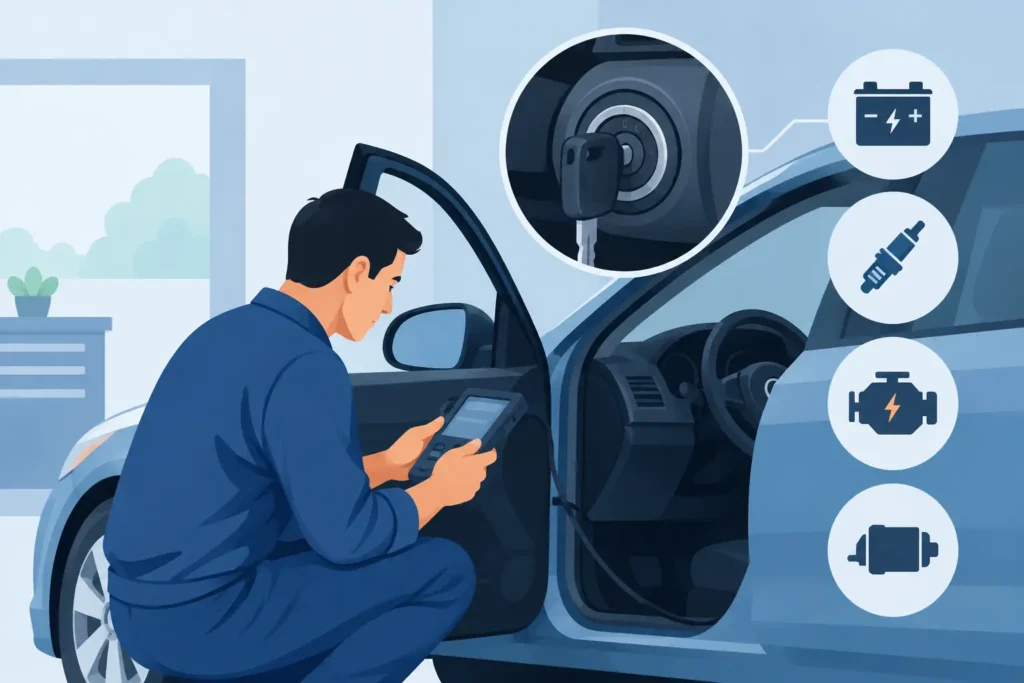
Your car may be parked safely in the driveway, yet the key will not turn, the push-button start does nothing, or the engine cranks without starting. Knowing how to diagnose ignition failure helps you describe the problem accurately and avoid replacing the wrong part. What drivers call an “ignition problem” can come from the key, ignition cylinder, immobilizer system, battery, starter, or fuel and engine controls.
The useful first step is to notice exactly what happens when you try to start the vehicle. A few details – whether the dash lights come on, whether the key turns freely, whether the engine cranks, and whether a spare key works – can point a qualified automotive locksmith or mechanic in the right direction.
Start by Identifying the Symptom
“Ignition failure” is a broad description, not a single diagnosis. Separate the problem into one of these common situations before assuming the ignition itself has failed.
If the key will not insert fully, will not turn, or feels jammed in the cylinder, the issue may be mechanical. A worn key blade, damaged wafers inside the ignition cylinder, debris, or steering-wheel pressure can prevent normal operation.
If the key turns and dashboard lights appear, but the engine does not crank, consider the battery, starter circuit, neutral safety switch, brake-pedal switch, clutch switch, or electronic anti-theft system. When the engine cranks normally but does not start, the ignition lock is usually not the main suspect. That situation may involve fuel delivery, spark, sensors, or an immobilizer that is not recognizing the key.
For push-button-start vehicles, a weak key fob battery, damaged fob, programming issue, or vehicle battery problem can look like an ignition failure. The vehicle may display “Key Not Detected,” “No Key,” or a similar warning.
Check the Simple Causes First
Before forcing the key or arranging a tow, check the conditions that commonly create a no-start complaint.
Look at battery behavior
Turn on the headlights or interior lights. If they are very dim, flicker, or shut off when you attempt to start the car, the vehicle battery or its connections may be weak. A single click when turning the key can also indicate a battery, cable, or starter issue.
A healthy-looking dashboard does not completely rule out a battery problem, especially on modern vehicles. Enough power may remain for accessories while voltage drops too low to operate the starter or electronic modules correctly.
Relieve steering-wheel pressure
On many vehicles, the steering lock can bind after the wheel is turned hard against the curb or held under pressure when the car was parked. With the parking brake set and your foot on the brake, gently move the steering wheel left and right while applying light, steady pressure to turn the key.
Do not twist the key aggressively. A key that bends or breaks in the ignition turns a relatively simple issue into a broken-key extraction and possible ignition repair.
Confirm the vehicle is in the correct gear
An automatic vehicle should be firmly in Park. If it does not start, hold the brake and try Neutral. A manual transmission normally requires the clutch pedal to be fully depressed. These checks are simple, but they can distinguish a gear-position or safety-switch problem from an ignition fault.
Try a known working spare key
A spare key is one of the best diagnostic tools a vehicle owner can have. If the spare starts the car and the primary key does not, the problem is likely the worn key blade, damaged transponder chip, weak fob battery, or key programming – not the ignition cylinder itself.
This matters because a modern key can fail in more than one way. The metal blade may turn the lock, while the transponder chip is no longer recognized. In that case, the engine may crank but immediately stall, or the anti-theft indicator may flash.
How to Diagnose Ignition Failure at the Key and Cylinder
A mechanical ignition cylinder usually gives warning signs before it stops working completely. The key may need to be wiggled, only work in one position, stick during removal, or turn inconsistently. Those symptoms often point to wear inside the cylinder or wear on the key cuts.
Examine the key under good light. Look for rounded edges, cracks near the head, a bent blade, or teeth that appear noticeably worn. Avoid using a heavily worn duplicate as your everyday key. Copies made from a worn key can repeat and worsen the original wear pattern.
If your key will not turn, avoid sprays that leave oily residue inside the ignition. Some products can collect dirt or interfere with delicate internal components. A professional automotive locksmith can inspect the key and cylinder, determine whether the issue is a worn key or damaged ignition, and discuss repair or replacement options.
A key that turns but will not return from the start position, or one that cannot be removed, also deserves prompt attention. Continuing to drive with an unreliable ignition can leave you stranded or increase damage to the cylinder.
Watch for Immobilizer and Smart-Key Clues
Most late-model cars use an immobilizer system. The vehicle must recognize the transponder in the key or the smart fob before it will allow normal starting. This protection is useful, but it adds another possible cause when the car will not start.
Look for a security or key-shaped warning light on the instrument cluster. A flashing or illuminated anti-theft light after a failed start can suggest that the key is not being recognized. Water exposure, a dropped key fob, a dead fob battery, internal damage, or an improperly programmed replacement key can all cause this issue.
Many push-button-start vehicles have an emergency recognition procedure, often involving holding the fob close to the start button or a designated backup location. The exact method depends on the make and model, so use the owner’s manual rather than guessing. If the car starts with its backup procedure, the fob battery or fob itself is a likely concern.
Know When It Is Probably Not the Ignition
A true ignition-cylinder issue is only one possible reason a vehicle will not start. If the key turns normally and the dashboard powers up, the cylinder may be doing its job.
A rapid clicking sound commonly points to low battery voltage. One heavy click with normal lights may suggest a starter or connection issue. A crank-no-start condition can involve fuel, spark, sensors, or an immobilizer. No sound at all may involve a brake switch, clutch switch, starter relay, battery connection, or electronic control issue.
That distinction saves time. An automotive locksmith can help when the key, fob, transponder, ignition cylinder, or ignition-related security system is the source of the problem. If testing points to engine, fuel, or starter repair, a qualified auto repair shop may be the better next step.
When to Call a Mobile Automotive Locksmith
Professional help is a good idea when the key is stuck, broken, or will not turn; when a spare key works but your daily key does not; when the vehicle shows a key or anti-theft warning; or when you need a replacement key programmed after losing the original.
Locksmith Squad provides mobile automotive locksmith service throughout Tampa Bay and can come to your vehicle for many key, fob, transponder, ignition, and broken-key concerns. We work with most major American, Asian, and European vehicle brands using professional key-cutting and programming equipment.
When you call or text, have your vehicle year, make, model, location, and a clear description of the symptom ready. Let us know whether the key turns, whether the engine cranks, whether any warning lights appear, and whether you have a working spare. Those details help us confirm availability and provide a straightforward estimate.
Avoid These Common Mistakes
Do not force a key that is binding, repeatedly jump-start a vehicle without checking the battery condition, or buy an unprogrammed online key and assume it will start the car. A replacement remote may look correct but still need the right chip, correct key blade, and proper programming for that exact vehicle.
Also avoid disconnecting the battery as a first response to an anti-theft warning. On some vehicles, that can erase useful symptoms without fixing the underlying problem. A careful diagnosis is usually faster than guessing.
A car that will not start is frustrating, but the symptoms often tell a clear story. Pay attention to what the key, dashboard, and engine do, protect the ignition from force, and get qualified help when the issue involves the key or vehicle security system.