
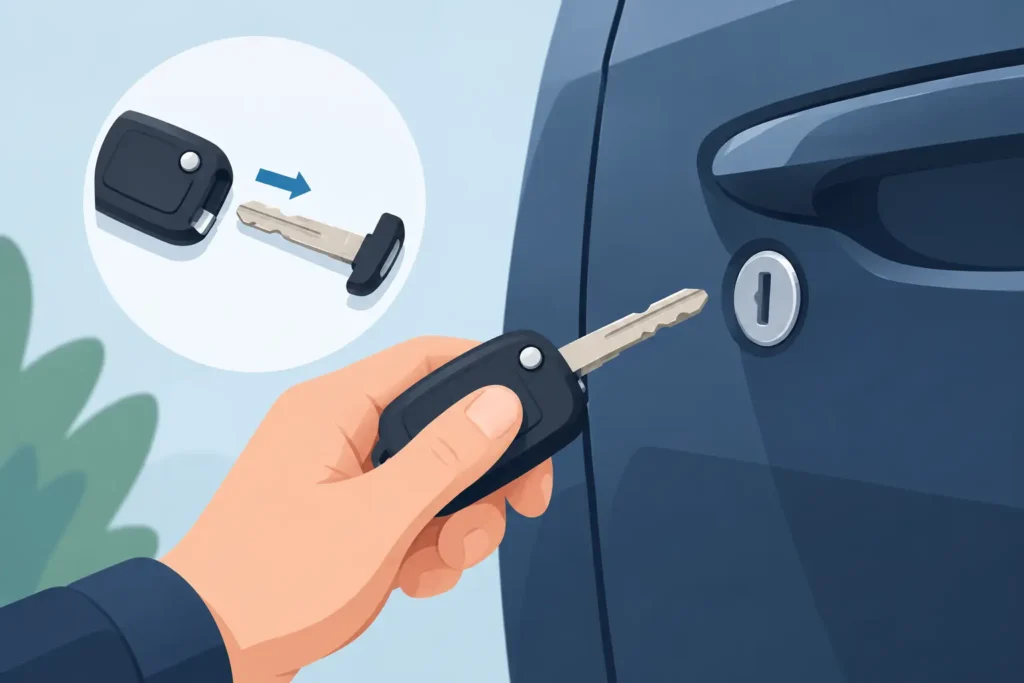
A dead key fob battery can leave you standing beside a perfectly good vehicle with no obvious way in. That is when you may need to use emergency key blade access – the small mechanical key hidden inside many smart remotes and key fobs. It is a useful backup, but it is not always as simple as pulling it out and turning a lock.
For most vehicles, the emergency blade is intended to unlock the driver’s door when the remote will not respond. It may help you get into the vehicle, retrieve a charger, access the hood release, or replace the fob battery. Whether it can start the vehicle depends on the make, model, ignition design, and key system.
What an emergency key blade actually does
An emergency key blade is a physical metal key stored inside, attached to, or supplied alongside a smart key fob. Manufacturers use different names for it, including mechanical key, valet key, insert key, or emergency key. The purpose is the same: it provides a manual way to access the vehicle if the electronic remote is unavailable.
On many push-button-start vehicles, the blade opens the door but does not start the engine. The vehicle still needs to recognize the transponder or smart fob. If the fob battery is dead, many vehicles have a backup recognition location, often near the start button, steering column, center console, or cup holder. Your owner’s manual can identify that location.
Some vehicles with a traditional keyed ignition may allow the mechanical blade to unlock the door and turn the ignition. Others use a separate transponder chip, meaning the blade alone can turn the cylinder but will not start the engine without a programmed key component nearby.
How to use an emergency key blade without damaging the lock
Start by locating the release on your fob. It is usually a small sliding latch or button on the back or side of the remote. Hold the release while pulling the metal blade out. Avoid prying the fob case open with a screwdriver or twisting the blade hard – plastic remote housings and release tabs can break.
Next, find the mechanical door lock. On many newer cars, it is hidden behind a small cap on the driver’s door handle. Look along the underside or rear edge of the handle for a narrow slot. Insert the emergency blade carefully into that slot and gently release the cover. Do not force the cover, because the retaining clips can crack or disappear into the parking lot.
With the lock cylinder exposed, insert the blade fully and turn it steadily. If it resists, stop. A lock may feel tight because it has not been used in years, especially in Florida humidity, rain, and road grime. Repeated force can bend the blade, break it in the lock, or damage the cylinder. A professional automotive locksmith can lubricate, service, or repair a stubborn door lock without creating a larger problem.
After the door unlocks, the alarm may sound. That can be normal on some vehicles when the door is opened mechanically rather than electronically. Pressing the unlock button on a working fob, starting the vehicle with the recognized smart key, or following the vehicle’s backup start procedure may silence it. Do not assume a sounding alarm means the key blade is wrong.
If the fob battery is dead
Once you are inside, check whether your vehicle has a designated emergency start position. Hold the fob against that location while pressing the brake and start button, or follow the exact steps in the owner’s manual. Many smart-key systems can read the chip in the fob at close range even when the removable battery is weak or fully dead.
If the vehicle still does not recognize the fob, the issue may be more than a battery. The fob could have water damage, a broken circuit board, a worn internal battery contact, or lost programming. In that situation, replacing the battery again will not solve the underlying problem.
When the emergency blade will not work
A blade that will not turn is not always cut incorrectly. The door-lock cylinder may be seized, worn, or damaged. On a used vehicle, someone may have replaced the door or lock cylinder without matching it to the original key. In rare cases, the emergency blade is simply a blank or was cut from incorrect information.
It also matters whether you have the correct blade for that fob. Some remotes look nearly identical but use different blade profiles. A blade can slide into a lock yet fail to turn if its cuts or keyway are not correct.
Do not use pliers, vise grips, lubricant sprays not intended for locks, or excessive leverage to make the blade turn. Those shortcuts often convert a fob issue into a broken-key extraction or door-lock repair. If you are locked out, a mobile locksmith has the tools to gain entry carefully and assess whether the blade, lock, or remote is the source of the issue.
Can you start a car with only the emergency key blade?
It depends on the vehicle. The emergency blade may start an older vehicle with a conventional ignition and a matching transponder key design. On most late-model push-button-start cars, however, the blade is only for mechanical entry. The smart fob must still be present and recognized by the vehicle.
That distinction is especially important after losing a smart key. Having an emergency blade cut does not create a complete replacement key. A complete smart-key replacement usually requires the correct remote, a properly cut emergency blade, and programming so the vehicle recognizes the fob. The same applies to many transponder keys and key fob replacements.
A qualified automotive locksmith can determine which parts your vehicle needs before cutting or programming anything. This avoids paying for a blade that opens the door but does not address your ability to drive.
Keep the blade ready before you need it
Take a minute to practice removing the emergency blade while you are at home, not during a rainstorm or after a late shift. Check that it enters the driver’s door lock smoothly, then store it back in the fob. If the lock is stiff now, have it looked at while you still have working access to the vehicle.
It is also wise to replace a weakening fob battery before it fails completely. Common warning signs include reduced remote range, inconsistent locking, dashboard messages about the key battery, or needing multiple button presses. Battery replacement is simple on many remotes, but take care not to damage the circuit board, lose a small contact spring, or install the battery backward.
For families, fleet vehicles, and anyone who depends on a car for work, a programmed spare key is more useful than hoping the emergency blade will cover every situation. A spare can prevent a lockout, reduce downtime after a lost key, and give you a backup if a primary fob is damaged or water-exposed.
Professional help for a damaged or missing emergency blade
If the emergency blade is broken, missing, bent, or trapped in the door lock, the solution should match the vehicle rather than rely on a universal key. Locksmith Squad provides mobile automotive locksmith service throughout Tampa Bay and can come to your location for emergency key cutting, broken key extraction, car key replacement, key fob programming, and ignition-related concerns.
We work with many American, Asian, and European vehicle brands, including Ford, Chevrolet, Toyota, Honda, Nissan, Hyundai, Kia, BMW, Mercedes-Benz, Audi, and Volkswagen. For the most accurate availability and estimate, call or text with your vehicle’s year, make, model, location, whether any keys still work, and what happened to the emergency blade or fob.
An emergency key blade is a practical backup, not a substitute for a functioning programmed key. Keep it accessible, use it gently, and get the lock or fob checked before a small inconvenience leaves you stranded.