
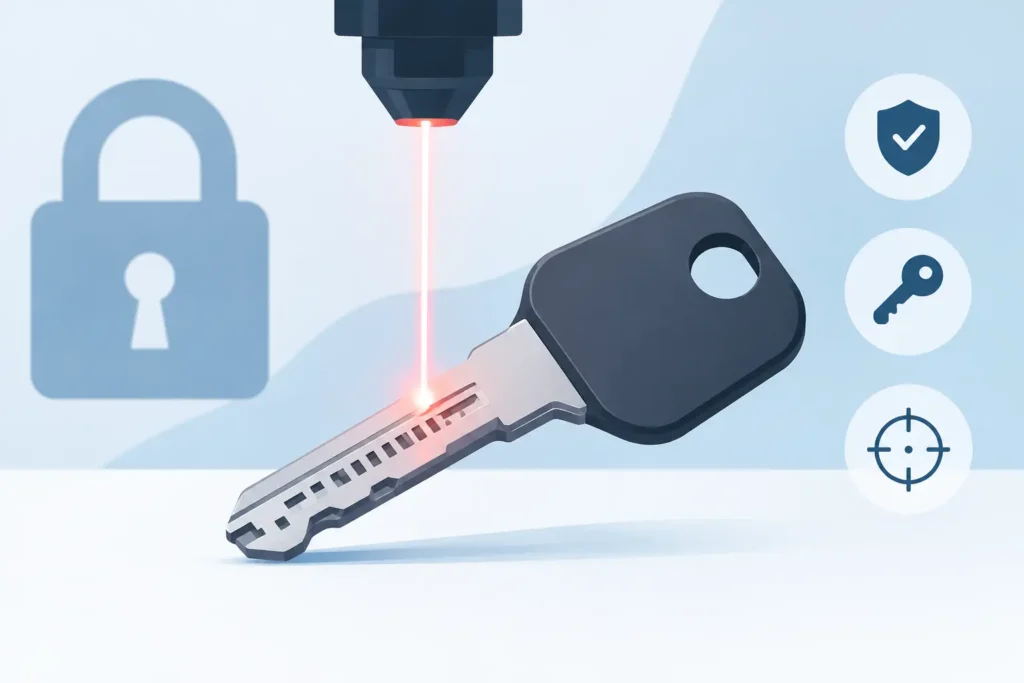
A car key with a narrow groove running down the center can look like it belongs in a sci-fi movie, especially beside an older metal key with teeth cut along one edge. These are commonly called laser keys, and while the name is widely used, they are not actually cut with a laser. They are precision-cut vehicle keys that often require specialized equipment, the right key blank, and in many cases, programming before the car will start.
If you have lost one, broken one, or want a spare before the only working key disappears, understanding the difference matters. A key that fits the door but will not start the vehicle is not a complete replacement. We help drivers throughout Tampa Bay with mobile key cutting and programming so they can get the right solution at their vehicle instead of trying to sort out parts, blanks, and programming on their own.
What Are Laser Keys?
Laser keys are more accurately called sidewinder keys or center-cut keys. Unlike a traditional key, which has cuts along one or both outer edges, a sidewinder key has a winding pattern cut into the flat center of the blade. The pattern is typically cut on both sides, creating a thicker, more symmetrical key.
Automakers began using this design more widely because it is harder to duplicate with a basic hardware-store key machine. The keyway in the vehicle lock is also more complex, which can provide better resistance to simple picking and unauthorized duplication.
Many laser-cut car keys also contain a transponder chip. That chip communicates with your vehicle’s immobilizer system. Even when the metal blade is cut perfectly, the engine may not crank or stay running until the chip is programmed to the car.
This is why a laser key issue is often two jobs in one: precision mechanical cutting and electronic programming.
Which vehicles may use them?
Laser-cut keys appear on many American, Asian, and European vehicles, although key designs vary by year, model, and trim. You may see them on certain Ford, Chrysler, Dodge, Jeep, Chevrolet, Cadillac, Honda, Toyota, Nissan, Lexus, BMW, Mercedes-Benz, Volkswagen, Audi, and Hyundai vehicles, among others.
The key style alone does not tell the full story. A vehicle may use a laser-cut blade with a basic transponder chip, a remote-head key with buttons, or a smart proximity fob that includes an emergency laser-cut insert. The vehicle identification number, year, make, model, and existing key type help determine what replacement is needed.
Why Laser Key Replacement Is More Involved
A standard house key can often be copied in a few minutes from an existing key. Automotive laser keys require more care because the key must match both the physical lock and the vehicle’s security system.
First, the blade has to be cut accurately. A worn key can be tricky because copying wear from an old blade may create a duplicate that works poorly. When appropriate, a professional locksmith can use vehicle key information and diagnostic tools to create a cleaner, properly matched cut rather than simply tracing a damaged key.
Then there is the electronic side. Most late-model vehicles use an immobilizer to prevent the engine from starting without an authorized key or fob. Programming may require professional diagnostic equipment, access procedures specific to the vehicle, and confirmation that the new key starts the car and operates the available functions.
Some makes and models have additional security steps. European vehicles, push-button-start systems, and certain newer domestic models can require more advanced programming procedures. That does not mean replacement is impossible. It means the correct method, equipment, and key type are essential.
Common Problems With Laser Keys
A laser-cut key is durable, but it is not immune to damage or electronic failure. Knowing what symptoms point to the key can help you avoid replacing the wrong part.
A blade may become worn, bent, or cracked after years of use. If it sticks in the ignition, turns inconsistently, or requires jiggling, the issue may be the cut, the keyway, or the ignition itself. Forcing it can break the blade or damage the ignition cylinder.
Remote-head laser keys can develop separate button or battery issues. If the remote stops locking the doors but the vehicle still starts, the problem may be the fob battery, buttons, or remote programming rather than the transponder chip. If the key turns but the security light stays on and the engine will not start, the transponder system may be involved.
Smart key systems create a different set of symptoms. A vehicle may display a “key not detected” message, work only when the fob is held close to the start button, or fail to recognize a fob after water exposure. The emergency insert inside the fob can unlock the door, but it generally cannot replace the electronic function needed to start a push-button vehicle.
Lost all keys versus making a spare
Making a spare while one working key remains is usually the simpler situation. The existing key gives us a starting point to confirm the blade style, remote functions, and programming requirements. You also keep the convenience of using your vehicle during the service.
When all keys are lost, the job is still often possible at your location, but it may involve additional steps. We need to identify the correct blank or fob, cut the emergency or mechanical key as needed, and program a key that the vehicle recognizes. Availability depends on the vehicle, its security system, and the parts required.
A spare is especially worthwhile for drivers who share a vehicle, manage a fleet, travel for work, or own a vehicle with a costly smart key. It is far less stressful to plan for a duplicate than to handle a no-key situation in a parking lot, at home, or after business hours.
Can a Hardware Store Copy Laser Keys?
Sometimes a retailer can physically duplicate a center-cut blade, but that is not always the same as replacing a functioning vehicle key. Many retail locations do not stock the correct automotive blank, cannot cut every sidewinder pattern, or do not provide programming for the transponder or remote.
There is also a quality question. An incorrect blank, an inaccurate cut, or a low-quality shell can leave you with a key that works intermittently or damages the ignition over time. For vehicles with chip keys, remote-head keys, or smart fobs, a complete replacement should be verified for starting, locking, unlocking, and any applicable remote functions.
The dealership is another option, particularly for certain highly restricted systems or keys that require manufacturer-specific access. However, dealership service may require towing if the vehicle cannot be driven. A qualified mobile automotive locksmith can often come to the vehicle, which saves you from arranging transport and waiting at a service department.
Mobile Help for Laser Key Problems
When you are stranded without a key, convenience is more than a nice extra. It changes the entire process. Mobile automotive locksmith service means the cutting and programming can be completed where the vehicle is located, whether that is your driveway, workplace, apartment complex, or a local parking area.
At Locksmith Squad, we use professional automotive key-cutting and programming equipment to service many major vehicle brands. We can assess whether you need a laser-cut key, transponder key, remote-head key, smart key, replacement fob, or an ignition-related repair. We also handle vehicle lockouts and broken key extraction when the situation involves more than a missing key.
There are limits worth mentioning. Not every key type is available at every moment, and certain vehicles require specific procedures or parts. Clear information before dispatch helps us set proper expectations and arrive prepared for the job.
What to Have Ready When You Call
For the fastest, clearest estimate, have your vehicle year, make, model, and current location available. Tell us whether you have any working keys, whether the key has buttons or a push-button-start fob, and what happened to the original key. A clear photo of the key or fob can also help identify the correct style.
If the key is stuck, broken, or turning poorly in the ignition, mention that before service begins. A key problem and an ignition problem can feel identical from the driver’s seat, but they require different repairs. Explaining the symptoms helps prevent guesswork.
Laser keys are designed to add security and convenience, but replacing one should not become a mystery. If your key is lost, damaged, worn out, or simply the last one you own, call or text Locksmith Squad with your vehicle information for availability and an estimate. A properly cut and programmed spare can turn a future emergency into a quick inconvenience instead.