
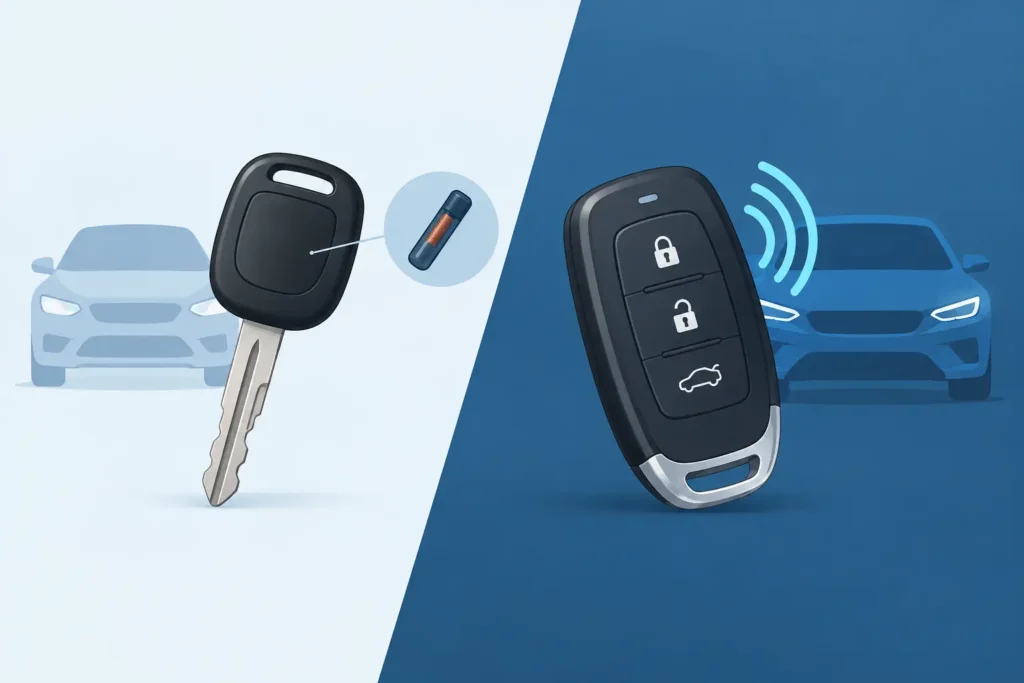
Your car key does more than turn a lock. On many vehicles, it must also prove to the vehicle that it is authorized to start the engine. That is the central difference drivers need to understand when comparing transponder keys versus smart keys. Both are electronic security keys, but they work differently, offer different conveniences, and require different replacement and programming procedures.
If you have lost a key, need a spare, or have a fob that stopped working, identifying the type of key your vehicle uses helps us give you clearer options. A mobile automotive locksmith can often cut and program the right replacement at your location, but the vehicle year, make, model, and available keys all matter.
What Is a Transponder Key?
A transponder key usually looks like a traditional car key with a plastic head. Inside that head is a small electronic chip. When you insert the key into the ignition and turn it, the vehicle reads the chip’s coded signal. If the code matches what the immobilizer system expects, the vehicle allows the engine to start.
The metal blade still has an important job: it operates the ignition and, on many vehicles, the door lock. But a correctly cut blade alone is not enough. A copied key without the properly programmed chip may turn in the ignition yet fail to start the vehicle.
Transponder technology became common because it adds theft deterrence without making the key difficult to use. You still insert and turn a key, but the vehicle checks for electronic authorization in the background. Many Ford, Chevrolet, Toyota, Honda, Nissan, Hyundai, Kia, Jeep, Chrysler, Dodge, and other vehicles use transponder-equipped keys, particularly across many late-1990s through 2010s models.
Some transponder keys also include remote buttons for locking doors, opening the trunk, or activating a panic alarm. That does not automatically make them smart keys. The distinction comes down to how you start and access the vehicle.
What Is a Smart Key?
A smart key, often called a proximity key or push-to-start key fob, lets you operate much of the vehicle without inserting a key into an ignition. With the fob nearby, you may be able to open the doors by touching a handle and start the vehicle by pressing the brake and the engine start button.
Instead of relying on a physical key being inserted into the ignition, the vehicle detects the fob through short-range communication. The fob and vehicle exchange encrypted information before the vehicle permits starting. Most smart keys also contain a hidden emergency metal blade. That blade can help you access the vehicle if the fob battery is weak, although it will not necessarily start the vehicle on its own.
Smart keys are common on newer trim levels and luxury vehicles, including many Lexus, BMW, Mercedes-Benz, Audi, Cadillac, Volkswagen, and newer domestic and Asian models. Still, features vary by year and model. A push-button-start vehicle generally uses a smart key, but the exact fob style and programming process can differ substantially between vehicles.
Transponder Keys Versus Smart Keys: The Practical Differences
The simplest way to separate these key types is by the driver’s routine. A transponder key typically goes into the ignition and is turned. A smart key generally stays in your pocket, bag, or console while you use proximity entry and push-button start.
Both types communicate electronically with the vehicle and both can be part of an immobilizer system. A smart key is not simply a transponder key with more buttons. It is usually a more advanced proximity device designed to communicate with the vehicle from a short distance. That added technology can bring more convenience, but it also means replacement can involve more specialized equipment, compatible fobs, and programming steps.
A transponder key is often the more straightforward option when you need a spare. Cutting the blade accurately and programming the chip are still essential, but the key itself is commonly less complex than a proximity fob. Smart key replacement may require programming the vehicle to recognize a new fob, confirming the remote functions work, and cutting or replacing the emergency blade if your vehicle has one.
Neither type is automatically better for every driver. A transponder key is simple, familiar, and practical. A smart key is convenient, especially when your hands are full or you make frequent short trips. The best choice is the system your vehicle was designed to use. You cannot usually convert a standard transponder-key vehicle into a push-to-start smart-key vehicle by purchasing a different fob.
Why Replacement Cost Can Vary
Customers often ask for a price before they know whether they have a chip key, remote head key, flip key, or smart fob. That is understandable, but the key type is only part of the answer. A replacement depends on the vehicle’s year, make, and model; whether all keys are lost; the type and availability of the key or fob; and the programming procedure required.
When one working key remains, making a duplicate can sometimes be more direct. When every key is lost, the vehicle may need a new key created from scratch and programmed into its immobilizer system. Some vehicles also require security information retrieval or additional diagnostic steps. European vehicles and late-model push-to-start systems can have especially specific procedures.
A damaged fob can create a similar question. Sometimes the issue is only a worn battery, damaged buttons, or a broken emergency blade. Other times, water exposure or internal circuit damage means the fob needs replacement and programming. Testing the situation before replacing parts helps avoid spending money on the wrong solution.
Common Signs You Have a Key or Fob Problem
A no-start condition does not always mean the key is at fault, but key-related issues have recognizable patterns. With a transponder key, the engine may crank but not start, or a security indicator may remain on or flash. With a smart key, the vehicle may display a message that it cannot detect the fob, or the push-button start may not respond even though the fob is inside the vehicle.
Start with the simple possibility: a weak fob battery. Smart keys and remote-equipped transponder keys rely on a battery for remote functions, although some transponder chips can still be read without one when inserted in the ignition. Your owner’s manual may show an emergency starting position for a smart fob with a weak battery, often near the start button or steering column.
If a fresh battery does not solve the problem, avoid forcing the emergency blade into the door or ignition. A bent blade, worn ignition, or damaged key housing can turn a minor key issue into a more involved repair. A qualified automotive locksmith can identify whether the problem is the key, fob, ignition, door lock, vehicle battery, or another system.
When Mobile Key Service Makes Sense
Towing a vehicle just because a key is missing is not always necessary. For many makes and models, a properly equipped mobile locksmith can come to your home, worksite, parking lot, or roadside location to cut and program a replacement. That is especially useful when you have lost your only smart key, broken a transponder key in the ignition, or cannot get the vehicle started.
At Locksmith Squad, we provide mobile automotive locksmith service throughout Tampa Bay and work with many major American, Asian, and European vehicles. Before dispatching, we will need your vehicle year, make, model, current location, and a description or photo of the key if available. Let us know whether any working keys remain, whether the vehicle uses a regular ignition or push-button start, and whether you need a spare, a lost-key replacement, or help with a damaged key.
Proof of ownership is also part of a professional car key replacement process. Having your registration, title, insurance information, or other appropriate documentation available can help keep the service moving smoothly.
Should You Keep a Spare?
For either key type, a spare is easier to arrange before the only key disappears. A spare transponder key can prevent a lockout from becoming a no-start problem. A spare smart key can be particularly valuable because replacing all lost proximity fobs may require more time and vehicle-specific programming than duplicating an existing one.
Store the spare somewhere safe, but not inside the vehicle. If you share a car with a family member, use it for a business fleet, or depend on it for daily work, having a tested backup key is a practical safeguard rather than an unnecessary extra.
Whether your vehicle uses a traditional chip key or a push-button-start fob, the right replacement is the one that is correctly cut, compatible with your vehicle, and properly programmed. If you are unsure which system you have, call or text us with your vehicle information for availability and an estimate before a small key issue leaves you without a way to drive.