
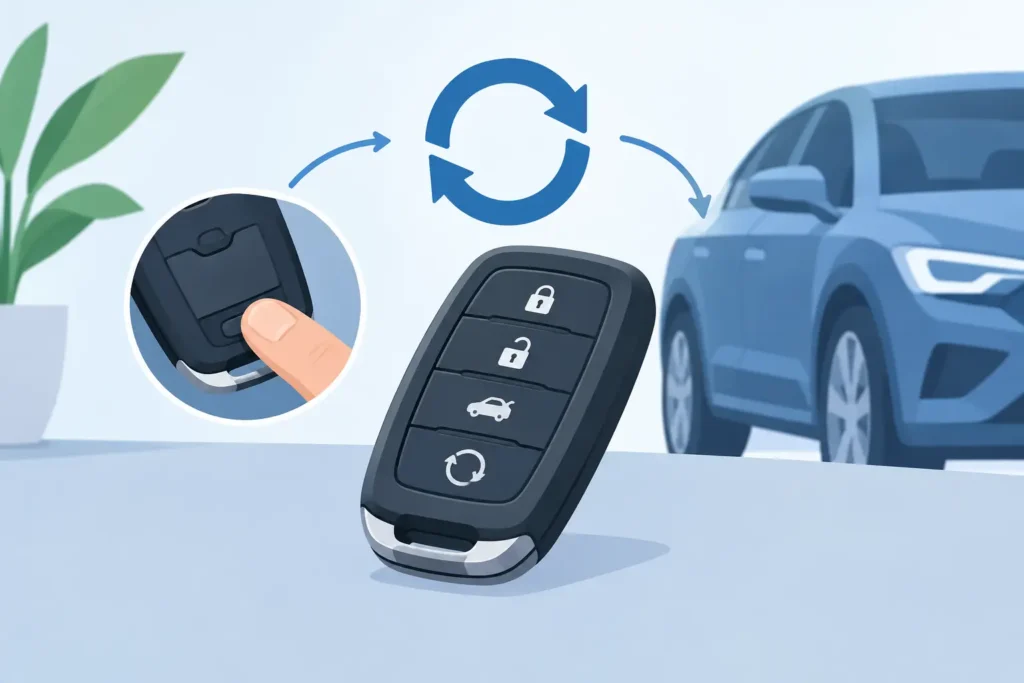
A key fob that suddenly stops locking, unlocking, or starting your vehicle can turn a normal stop into a major inconvenience. If you searched for how to reset key fob instructions, the right answer depends on what failed: the battery, the remote signal, the vehicle’s programming, or the fob itself. A quick reset may help in some cases, but modern smart keys and transponder keys often need more than a button sequence.
How to Reset a Key Fob Safely
Start with the simplest possibility: a weak or improperly installed battery. Many key fob problems look like programming failures when the actual issue is a battery that no longer has enough power to send a reliable signal. If your remote works only when you stand close to the car, works intermittently, or the buttons require repeated presses, replace the battery before trying anything else.
Use the battery type printed on the old battery or inside the fob housing. Common coin-cell batteries include CR2032, CR2025, and CR2016, but they are not interchangeable just because they look similar. Install the replacement with the positive and negative sides facing the same direction as the original. Then snap the case closed firmly without forcing it.
After changing the battery, stand near the vehicle and test every function: lock, unlock, trunk release, panic button, remote start, and any other buttons your fob has. If it begins working normally, no reset or programming is likely needed.
Try a basic remote reset only when appropriate
Some vehicles allow the remote portion of a key fob to be synchronized again through an ignition and button sequence. The exact steps vary by year, make, model, and key type. A procedure that works for an older Ford may not work for a newer Honda, Toyota, Chevrolet, BMW, or Jeep. Using the wrong sequence usually will not damage the car, but it can waste time and create more confusion.
Check your owner’s manual for instructions specific to your vehicle. If it provides a remote reprogramming process, follow it exactly, including door position, ignition cycles, and button timing. Keep all working remotes with you when the manual instructs you to do so. On some vehicles, programming one remote without the others present can cause the other remotes to stop working until they are programmed again.
Do not repeatedly cycle the ignition or press random button combinations from online videos. Modern vehicles use different security systems, and a procedure for one trim level or model year may not apply to yours.
A Reset Will Not Fix Every Key Fob Problem
A key fob is not always just a remote control. Many keys contain a transponder chip or smart-key circuit that communicates with the vehicle’s immobilizer system. That security system verifies the key before allowing the engine to start. Resetting the lock and unlock buttons does not necessarily restore that communication.
If the doors unlock but the car will not start, the problem may be with the transponder chip, the key’s internal electronics, the push-button start antenna, or the vehicle’s immobilizer system. If you see a security light or key warning on the dash, the vehicle may not be recognizing the key properly.
Likewise, if a push-to-start vehicle says “Key Not Detected” after a new battery is installed, the fob may need professional diagnosis or programming. Some vehicles have an emergency starting location, such as a marked spot in the console, cup holder, or steering column area where the fob can be recognized even with a weak battery. Your owner’s manual can identify that location.
Signs Your Key Fob Needs More Than a Battery
A reset is worth trying when the fob became unresponsive after a battery change, has intermittent button response, or was temporarily out of range. It is less likely to help when the fob has physical or electronic damage.
You may need professional key fob service if the fob was run through a washing machine, dropped hard, exposed to saltwater, or cracked open. Moisture can corrode the circuit board even after the outside appears dry. A damaged button pad, loose battery contact, broken solder connection, or failed circuit board can also leave a new battery unable to solve the problem.
Be careful with a fob that was exposed to water. Remove the battery as soon as possible and avoid pressing the buttons repeatedly. Do not use a high-heat dryer, which can warp the case or damage electronics. A technician can inspect whether the fob is repairable, but in many cases a replacement and programming will be the more dependable option.
Replacement fobs are not always ready to use
Buying a replacement remote online or from a parts store can seem straightforward, but compatibility is more detailed than matching the vehicle make and year. The replacement must have the correct frequency, board configuration, FCC identification when applicable, key blade type, and programming compatibility for your vehicle.
An aftermarket fob can be a practical choice for some vehicles, while an OEM fob may be preferable for others. The trade-off is usually cost, availability, features, and long-term reliability. A remote that looks identical may still fail to program if it has the wrong internal configuration.
Used key fobs can be especially unpredictable. Some can be reused only after being properly unlocked or reset with professional equipment. Others are locked to the original vehicle and cannot be reliably programmed to another one. Before purchasing a fob, confirm that it is appropriate for your specific vehicle rather than relying on appearance alone.
When Professional Key Fob Programming Is the Better Move
Most late-model vehicles require diagnostic programming equipment to add, replace, or register a key fob. This is particularly common with proximity smart keys, push-button start systems, encrypted transponder keys, and many European vehicles. In these cases, there may be no owner-accessible reset method at all.
A qualified automotive locksmith can determine whether your existing fob needs programming, repair, a new battery, or replacement. We can also cut an emergency key blade when your fob includes one, create a spare key before you lose the last working key, and program many replacement smart keys and transponder keys on-site.
Mobile service is especially useful when the vehicle cannot start or is parked at home, work, a shopping center, or on the roadside. Instead of arranging a tow for a key issue, you can have an automotive locksmith come to your location with the equipment needed to diagnose the problem and discuss the available options.
For service, have your vehicle’s year, make, model, current location, and a description of the problem ready. Let the technician know whether you have any working keys, whether the vehicle starts, and whether the fob was damaged or exposed to water. A vehicle identification number may also be needed to verify the correct key and programming process.
Protect Your Working Key Fob From the Next Failure
Once your fob is working again, consider getting a spare while at least one key still operates the vehicle. Adding a duplicate is often simpler than replacing all keys after the last one is lost. It also gives another driver in the household a reliable backup.
Keep fobs away from moisture, avoid leaving them in direct heat, and replace the battery at the first sign of reduced range. If your key has an emergency blade, make sure it can be removed and that you know where the mechanical door lock is located. That small bit of preparation can be very helpful during a dead-battery or lockout situation.
If a battery replacement and vehicle-specific reset do not restore normal operation, Locksmith Squad can provide mobile key fob replacement and programming throughout Tampa Bay. Call or text with your vehicle information and location for availability and an estimate, so you can get a clear answer before a key fob problem leaves you stranded.