
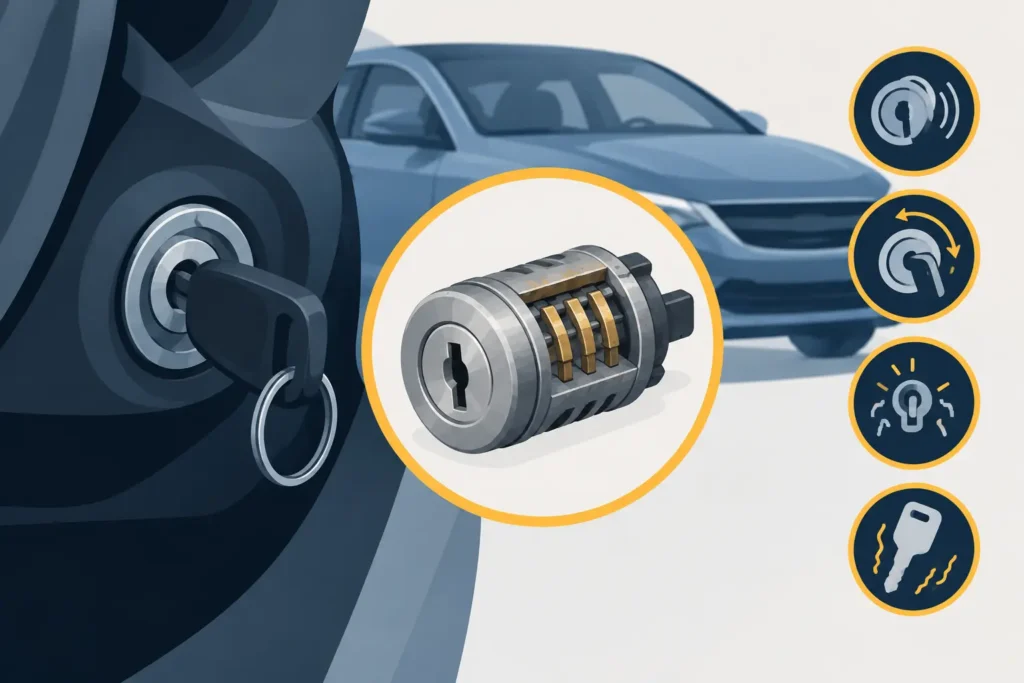
A key that suddenly needs to be wiggled, pushed harder, or turned just right is more than an everyday annoyance. It can be one of the top signs ignition cylinder wear is developing inside your vehicle. If the mechanical portion of the ignition fails completely, you may be left with a car that will not start – even if you still have a working key in hand.
The good news is that many ignition problems give you warning before they become a roadside issue. Knowing what those warnings mean can help you avoid breaking a key, damaging the ignition further, or arranging an unnecessary tow.
What an ignition cylinder does
The ignition cylinder is the keyed mechanical component where you insert and turn a traditional car key. Small internal pins are aligned by the cuts on your key. When the correct key lifts those pins to the proper positions, the cylinder can rotate and activate the ignition switch behind it.
Over years of driving, both the key and those internal components can wear down. A worn key may no longer position the pins precisely. The pins, springs, and cylinder housing can also become worn, dirty, or damaged. On many modern vehicles, the mechanical cylinder works alongside a transponder chip, remote, or smart-key system, so a no-start condition is not always caused by the cylinder alone.
That distinction matters. A professional automotive locksmith can evaluate the key, cylinder, and vehicle security system before recommending repair or replacement.
Top signs of ignition cylinder wear to watch for
Your key sticks when going in or coming out
A key should slide into the ignition without excessive resistance. If you have to angle it, pull it back slightly, or repeatedly insert it before it seats, the keyway or internal pins may be worn or obstructed.
Dirt, lint, and debris can contribute to this issue, particularly in older vehicles. Still, recurring sticking often points to a worn key or cylinder rather than a simple cleaning need. Do not force the key. Excess force can bend it or break it off inside the ignition, turning a repair issue into a broken-key extraction situation.
The key turns only after wiggling or jiggling it
One of the most recognizable signs is a key that turns only when you move it up and down, side to side, or slightly in and out. That usually means the key cuts are no longer lining up cleanly with the cylinder pins.
This may happen intermittently at first. You might have a normal start in the morning and trouble at the gas station later that day. Intermittent operation does not mean the problem has resolved. It often means the cylinder is getting close to a point where it may not release at all.
You need unusual pressure to turn the ignition
The key should turn smoothly from the lock position to accessory, on, and start. If it feels tight, gritty, or resistant, stop before applying more force. A key can twist or snap, especially if it has already become thin from years of use.
There is one common exception: steering wheel lock pressure. If the wheel was turned firmly after parking, the steering lock can bind the ignition. Gently move the steering wheel left and right while applying light turning pressure to the key. If that releases it, the issue may be the steering lock rather than cylinder wear. If resistance continues regularly, have it inspected.
The key comes out while the vehicle is running
A key that can be removed in the on or run position is a serious warning sign. The ignition cylinder is not holding the key in its intended position, which can indicate significant internal wear or damage.
Do not ignore this symptom. Depending on the vehicle, a loose cylinder may also affect how reliably the ignition remains in the correct operating position. Arrange an evaluation soon rather than continuing to use the vehicle normally.
The key will not turn back to the lock position
Sometimes the cylinder turns forward but will not return fully to the lock position. You may have trouble shutting the vehicle off, removing the key, or locking the steering column. This can be caused by a damaged cylinder, a worn key, or a problem in the steering-column mechanism.
Because several components can create similar symptoms, guessing can be expensive. A qualified locksmith can determine whether the key is the problem, whether the cylinder needs service, or whether a different vehicle component is involved.
Your key is visibly worn, bent, or damaged
Look closely at the metal blade. Worn edges, rounded cuts, cracks near the head, and bending are all worth taking seriously. A key can wear gradually enough that you do not notice the change until the ignition starts acting up.
Using a badly worn original key to make another copy can reproduce the same problem. In many cases, the better solution is to create a properly cut replacement key using the vehicle’s key information, then test whether it operates the ignition correctly. If a correctly cut key still sticks or fails to turn, the cylinder may be the underlying issue.
When it may not be ignition cylinder wear
A vehicle that will not start does not automatically have a bad ignition cylinder. On vehicles with transponder keys, push-button start, smart keys, or electronic immobilizers, the issue may be related to key programming, a weak key fob battery, a damaged transponder chip, or an electrical starting problem.
For example, if your key turns normally but the engine does not crank, the mechanical cylinder may be fine. If a push-button-start vehicle says “key not detected,” there may not be an ignition cylinder involved at all. A dead vehicle battery, starter issue, or ignition switch failure can also create symptoms that feel similar from the driver’s seat.
That is why the details matter. When you call or text, share your vehicle’s year, make, model, location, whether the key turns, and whether you have another working key. Those details help us prepare the right equipment and give you a clearer idea of your options.
Avoid these quick fixes
When a key begins sticking, it is tempting to spray household lubricant into the ignition or force the key until it catches. Both can make matters worse. Heavy lubricants can collect dust and grime inside the cylinder. Forcing a key can damage internal pins, bend the blade, or cause it to break off.
Avoid hanging a heavy key ring from the ignition key as well. Over time, the extra weight can add strain to the cylinder and related steering-column components. If you have a separate remote, house keys, and several tags on one ring, separating the vehicle key is a simple preventive step.
If the key is stuck in the ignition, do not pull it with pliers. If it is not turning, do not use a screwdriver or attempt to take apart the steering column. Modern vehicles often contain sensitive wiring, airbag components, and electronic security systems around the column area.
What a mobile automotive locksmith can do
A professional automotive locksmith can come to your location, inspect the problem, and help you choose the appropriate repair. Depending on the vehicle and condition of the parts, the solution may involve cutting a new key, repairing or replacing the ignition cylinder, extracting a broken key, or programming a replacement transponder key or key fob.
At Locksmith Squad, we provide mobile automotive locksmith service throughout Tampa Bay and work with many domestic, Asian, and European vehicle brands. We use professional key-cutting and programming equipment to address both mechanical ignition concerns and modern vehicle-key issues. In many situations, mobile service means you can get help where the vehicle is parked instead of trying to arrange a tow to a dealership.
The exact repair depends on the vehicle. Some cylinders can be serviced or replaced while preserving key compatibility. Other situations may require a new key and cylinder setup. We will explain the available options clearly before work begins.
Do not wait for a complete ignition failure
An ignition that works only after several attempts is already asking for attention. It may continue working for days or months, but it can also fail on the next stop. Addressing the issue while the key still turns usually gives you more options and reduces the chance of a broken key or unexpected lockout.
If your key is sticking, turning roughly, or refusing to release, call or text Locksmith Squad with your vehicle information and location for availability and an estimate. A timely inspection can help keep a small ignition problem from becoming the reason your car cannot leave the driveway.