
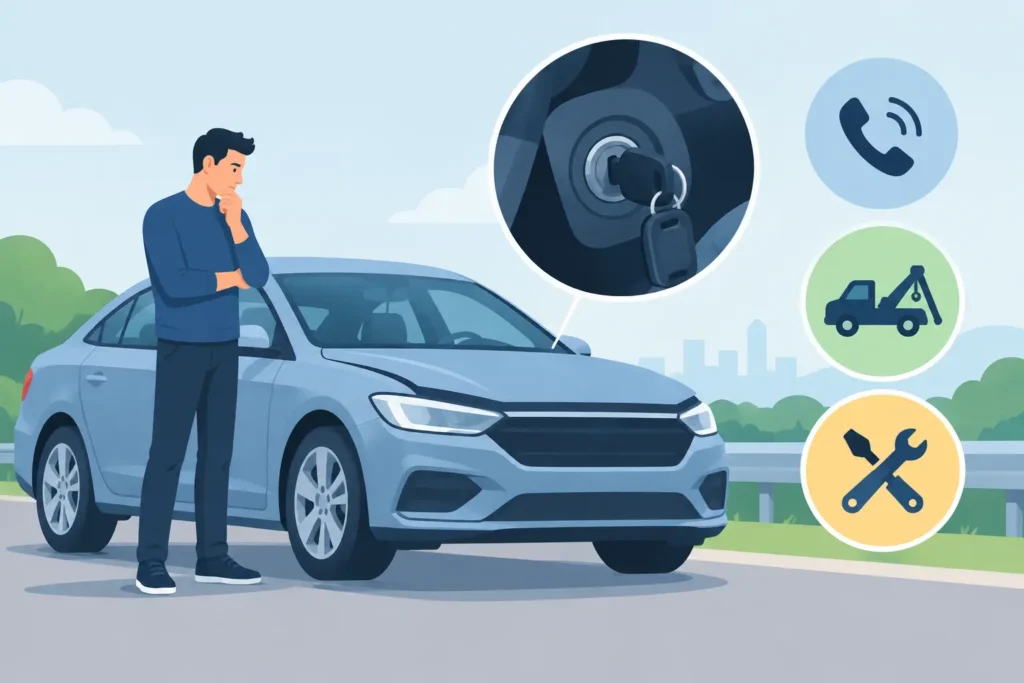
A vehicle ignition failure has a way of stopping your day at the worst possible moment. You may be parked at work, outside a store, in your driveway, or ready to pick up your family when the key will not turn, the fob is not recognized, or the vehicle will not start. The right next step depends on what is actually failing – the mechanical ignition, the key, the electronic immobilizer system, the battery, or the starter.
At Locksmith Squad, we help Tampa Bay drivers narrow down the problem and provide mobile ignition and car key services when a locksmith solution is the right fit. A clear diagnosis can help you avoid damaging the ignition cylinder, breaking a key, or paying for repairs you may not need.
What Vehicle Ignition Failure Can Look Like
“Ignition failure” is often used for any no-start condition, but several different issues can produce similar symptoms. If your key will not insert fully, will not turn, turns only after repeated attempts, or gets stuck in the ignition, the ignition cylinder or key may be worn or damaged. A broken key blade can also leave part of the key trapped inside.
On newer vehicles, the key may turn normally but the dashboard shows a key warning light, a “no key detected” message, or an immobilizer symbol. In that case, the problem may be a weak key fob battery, a damaged transponder chip, a programming issue, or a vehicle-side electronic fault. Push-button-start vehicles can have similar symptoms when the smart key is not detected.
There are also no-start problems that are not related to the ignition at all. Dim lights, clicking sounds, or no electrical response can point to a discharged battery or battery connection. A single click with normal dash lights may suggest a starter issue. The key point is that a vehicle that will not start does not always need an ignition replacement.
Common Causes of Ignition Problems
Mechanical ignition cylinders wear gradually. Over years of use, the small internal components that match your key can become worn, especially if the key is heavy with extra keychains or has been copied from an already worn key. The result may be a key that works sometimes, requires jiggling, or suddenly refuses to turn.
A worn or damaged key can create the same symptoms. If the blade is bent, cracked, badly worn, or separated from the remote housing, it may not align correctly inside the ignition. Continuing to force it can turn a manageable key issue into a broken-key extraction and ignition repair.
Electronic keys have their own failure points. Water exposure, a drop onto concrete, a dead fob battery, internal circuit damage, and lost programming can all prevent a transponder key or smart key from communicating with the vehicle. Some vehicles may still unlock with the emergency blade but will not start without a recognized chip or programmed fob.
In some cases, the steering wheel lock creates confusion. If the wheel is turned tightly against the curb or held under pressure, the ignition key may feel stuck. Gently move the steering wheel left and right while applying light turning pressure to the key. Do not twist the key aggressively. If it still will not move, stop before the blade bends or breaks.
What to Do When the Key Will Not Turn
Start with the simple checks. Make sure the vehicle is fully in Park, or in Neutral if it is a manual transmission. Confirm the parking brake is applied. If the steering wheel is locked, relieve pressure as described above. If you have a spare key, try it once. A spare that turns normally is a strong sign that your everyday key is worn or damaged.
Avoid sprays, lubricants, pliers, and excessive force. Household lubricants can collect dirt inside the cylinder, and tools can damage the key or ignition components. A key that turns intermittently is a warning sign, not a reason to keep testing it until it fails completely.
If the key is stuck in the ignition, do not pull hard. Check that the vehicle is in Park and that the battery has enough power for the shift interlock and ignition system to operate correctly. If the key remains stuck, a qualified automotive locksmith can assess whether the issue is the key, ignition cylinder, or a related vehicle component.
When a Smart Key or Transponder Will Not Start the Car
For a key fob or push-button-start vehicle, replace the fob battery if you have the correct battery and can do so without damaging the remote. If the vehicle provides an emergency starting location, such as a designated area near the start button or steering column, follow the instructions in the owner’s manual. This may allow the vehicle to read a weak fob at close range.
If you have a second programmed key or fob, test it. When the spare works and the primary fob does not, replacement or reprogramming may solve the issue. When neither key works, the cause could be vehicle-side electronics, a battery problem, or an immobilizer-related fault that needs further diagnosis.
We can replace and program many transponder keys, remote-head keys, key fobs, and smart keys for major American, Asian, and European makes. Availability and programming options vary by vehicle year, model, and system, so the vehicle information matters before any work begins.
How a Mobile Automotive Locksmith Can Help
A mobile automotive locksmith comes to the vehicle, which can be particularly helpful when the car cannot be driven or the key is stuck in the ignition. Depending on the diagnosis, service may include cutting a new key from vehicle information, extracting a broken key, repairing or replacing an ignition component, creating a programmed transponder key, or programming a new smart key or remote.
Ignition work is not one-size-fits-all. Some ignition cylinders can be repaired or rebuilt, while others require replacement. A replacement may need to be configured to work with your existing key or paired with newly cut keys. The best choice depends on the vehicle, the condition of the ignition, parts availability, and whether you want one key to operate both the doors and ignition.
For drivers in Brandon, Valrico, Tampa, Plant City, Lakeland, Clearwater, and nearby communities, mobile service can remove the inconvenience of arranging a tow for a key or ignition-related issue. It also allows the technician to test the key and vehicle together at the location where the problem occurred.
Information That Helps Us Diagnose the Problem
When you call or text for availability and an estimate, have your vehicle year, make, model, and current location ready. Let us know whether the key will not turn, will not come out, turns but does not start the vehicle, or has broken in the ignition. For fob and smart-key concerns, tell us whether the remote locks and unlocks the doors, whether any warning messages appear, and whether you have a working spare.
Photos can be useful too. A photo of the key, fob, ignition area, and vehicle identification information can help confirm the correct key type and programming requirements. This lets us give you a more accurate explanation of the available options before service begins.
Preventing Another Ignition Failure
If your key has started sticking or needs repeated attempts, address it before it becomes an emergency. Having a properly cut spare key gives you a practical test when your daily key starts acting up. For smart keys, replace weak fob batteries promptly and keep the remote dry. Avoid carrying an oversized, heavy keychain on a traditional ignition key.
A spare is also useful after ignition repair or car key replacement. It gives you a backup if a key is lost, damaged, or left inside the vehicle, and it can save time when diagnosing whether the issue is the key or the car itself.
If your vehicle is stranded because the key will not turn, the ignition is damaged, or a programmed key is no longer recognized, do not force the issue. Call or text Locksmith Squad with your vehicle details and location, and we will explain the mobile service options available for your situation.