
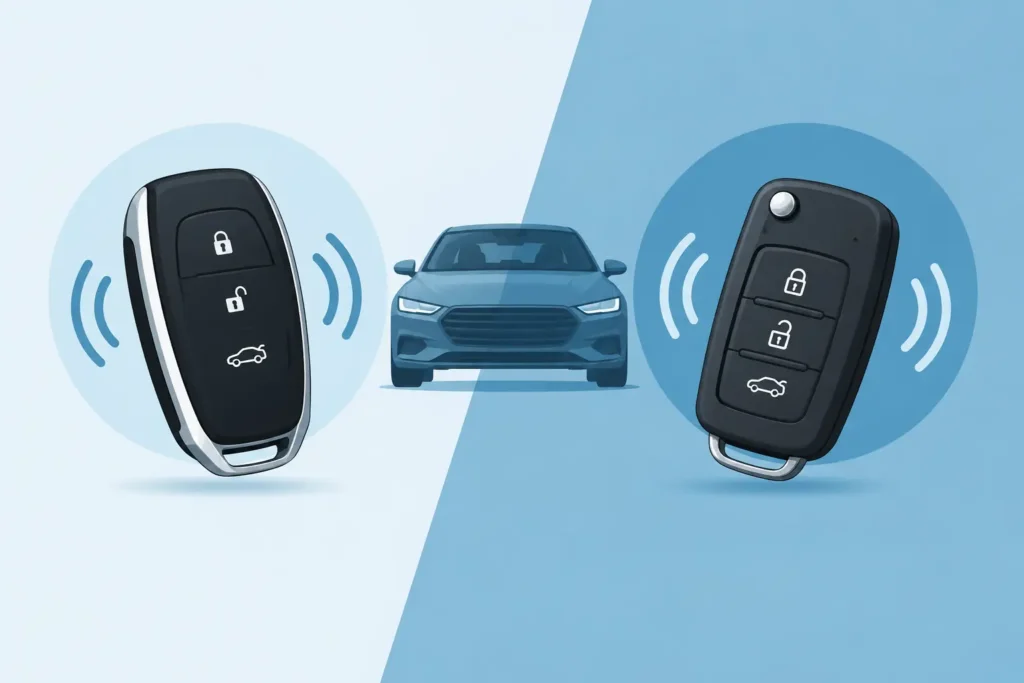
Your car key may look like a small plastic fob, but what is inside it determines how the vehicle starts, how it recognizes you, and what it takes to replace it. In the smart key versus remote comparison, the biggest difference is usually not the buttons. It is whether you must insert a key or fob into the vehicle to start it, or whether the car detects an authorized key nearby.
That distinction matters when a key is lost, damaged, or needs a spare. A remote may need a battery, a replacement shell, a new internal chip, or programming. A smart key can require specialized diagnostic equipment and a properly compatible fob to communicate with the vehicle. Knowing what you have helps you get the right service without guessing.
What Is a Remote Car Key?
A remote is a key or key fob that sends a radio signal to control vehicle functions from a short distance away. Most people know it as the device with buttons for locking the doors, opening the trunk, sounding the panic alarm, or starting the vehicle remotely when equipped.
A basic remote does not necessarily start the car. Many vehicles use a separate mechanical key blade to turn the ignition. Others have a transponder key, where a small security chip in the key must be recognized by the vehicle before the engine will start. The remote buttons and the transponder chip can be housed in the same key head, but they perform different jobs.
For example, an older Ford, Chevrolet, Toyota, Honda, or Nissan may use a metal key with a plastic head. The metal blade operates the ignition, while the chip inside the head handles the anti-theft authorization. If it also has buttons, it is commonly called a remote head key.
Remote key types vary by vehicle
A traditional remote can come in several forms. It may be a separate fob and key, a remote head key, or a flip key with a blade that folds into the fob. Some vehicles use a fob for door controls and a separate transponder key for the ignition.
Because these formats differ, buying a generic-looking fob is not always a solution. The frequency, chip type, button layout, emergency blade, and programming method must match your vehicle. A fob that looks right may still be incompatible.
What Is a Smart Key?
A smart key is designed for a push-button-start vehicle with proximity access. Instead of inserting a key into a traditional ignition cylinder, you carry the smart fob with you. When the fob is within range, the vehicle can detect its encrypted signal and allow you to start the engine by pressing the brake pedal and the start button.
Many smart keys also support hands-free entry. The vehicle senses the fob near the door, and touching the handle or pressing a request sensor lets you enter without taking the fob out of your pocket or bag. Exact features depend on the make, model, and trim level.
Most smart fobs still contain a hidden emergency key blade. That blade is there for situations such as a dead fob battery or an electronic access problem. It can often open the driver door through a concealed mechanical keyway. It does not mean the blade alone will start the vehicle.
Smart keys are common on newer vehicles from brands including Hyundai, Kia, Lexus, Nissan, Toyota, Ford, Jeep, BMW, Mercedes-Benz, Audi, Volkswagen, and Cadillac. However, a push-button start does not tell the whole story. Each manufacturer uses its own security system, and even different model years can have different programming requirements.
Smart Key Versus Remote: The Practical Difference
The simplest way to tell them apart is to look at how the car starts. If you put a key into an ignition cylinder and turn it, you likely have a traditional key, often with a transponder chip and possibly remote buttons. If you press a start button while the fob stays in your pocket, you likely have a smart key.
A remote mainly sends commands when you press its buttons. A smart key communicates with the vehicle automatically when it is nearby, while still providing buttons for manual control. Both can use batteries, both can be programmed, and both may include an emergency metal blade. That overlap is why the terms are often used interchangeably.
The replacement process is where the difference becomes more noticeable. Replacing a basic remote may only involve programming door-lock functions. Replacing a transponder key requires programming its chip so the anti-theft system permits starting. Replacing a smart key usually requires pairing the fob to the vehicle’s proximity and immobilizer system, along with cutting the emergency blade if needed.
Why a New Fob Does Not Always Work Right Away
A replacement key has to be more than physically similar to your old one. It needs the correct electronics and a successful programming procedure. On many vehicles, the car will not start until its security system accepts the new chip or smart fob.
This is especially relevant after losing every working key. Without an existing key, the programming path can be different and may require obtaining vehicle security information through appropriate verification procedures. Some makes also have systems that limit which replacement keys can be added or require advanced tools to complete the job.
A used fob can create complications as well. Certain vehicle systems may not accept a previously programmed fob, even if the outside looks identical. Water damage, worn buttons, damaged circuit boards, and incorrect aftermarket parts can also lead to intermittent or failed operation.
A professional automotive locksmith can identify the type of key system, verify the compatible replacement, cut an emergency blade when applicable, and program the key using vehicle-specific equipment. This approach is useful whether you need one working key restored or want a spare before an emergency happens.
Signs Your Key Needs Attention
A dead battery is one of the most common fob problems. You may notice shorter range, inconsistent button response, or a dashboard message indicating that the key battery is low. Replacing the battery may restore normal operation, but it will not repair a broken chip, damaged board, or lost programming.
For smart keys, the vehicle may show a “key not detected” message even though the fob is in the cabin. Try holding the fob near the start button or the backup detection area listed in your owner’s manual. Many push-button vehicles have an emergency starting procedure intended for a weak fob battery. If the message continues after a fresh battery, the fob or vehicle system should be checked.
Do not ignore a damaged emergency blade either. A bent, cracked, or broken blade can leave you without a mechanical way to enter the vehicle if the fob battery fails. If the key turns roughly in the door or ignition, forcing it can damage the lock or leave part of the key inside.
When to Make a Spare
The best time to replace a key is usually before it is the only key left. A working spare gives you options if your primary fob is lost, run over, dropped in water, or locked inside the vehicle. It can also reduce downtime for families, employees, and fleet vehicles that depend on one car or truck every day.
If you have one working smart key or remote, let the locksmith know. In many cases, having that key available makes identification and programming more straightforward. Share the vehicle year, make, model, trim if known, your location, the key type, and whether any keys still work. A photo of the existing key can also help confirm the correct style.
For drivers in Tampa Bay, mobile automotive service avoids the inconvenience of arranging a tow for many key-related situations. Locksmith Squad can come to your location for compatible car key replacement, smart key creation, key fob programming, transponder key service, emergency key cutting, and vehicle lockout help.
A car key should not become a crisis just because it has a small crack, a weak battery, or one unreliable button. If your fob is showing early warning signs, call or text with your vehicle information and ask about a properly matched spare before you need one urgently.