
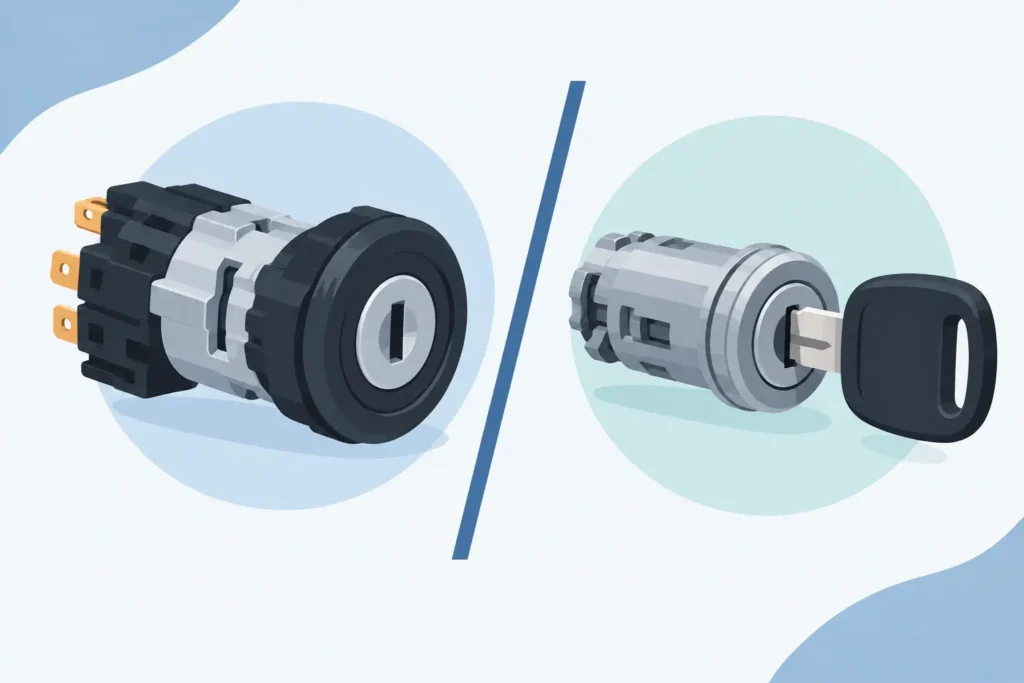
Your key may turn normally, but the dash stays dark. Or the key may refuse to turn at all, even though the battery is fine. The ignition switch versus cylinder question matters because these are separate parts with different jobs, symptoms, and repair options. Knowing which one is likely failing can help you describe the problem clearly and avoid replacing the wrong component.
For drivers in Tampa Bay, ignition trouble can quickly turn into a missed appointment, a stranded family vehicle, or downtime for a work truck. A qualified mobile automotive locksmith can often diagnose the key, ignition cylinder, and related components at your location, then explain the practical next step.
Ignition Switch Versus Cylinder: What Each Part Does
The ignition cylinder is the mechanical part where you insert and turn a traditional metal key. Inside it are small pins or wafers designed to match the cuts on your key. When the correct key is inserted, those components align and allow the cylinder to rotate.
The ignition switch is usually an electrical component connected behind or alongside the cylinder. As you turn the key, the switch sends power to different vehicle systems. In older vehicles, it commonly controls accessory power, the ignition system, and the starter circuit. In many newer vehicles, it communicates with additional electronic and anti-theft systems.
Put simply, the cylinder recognizes and turns with the key. The switch tells the vehicle what to do after that turn. Depending on the vehicle, they may be connected as a single assembly or serviceable as separate parts. That is why the right repair depends on the vehicle’s design and the actual failure.
What changes with push-button start
A push-button-start vehicle may not have a conventional ignition cylinder at all. It relies on a smart key, key fob, antennas, modules, and an electronic start button. If the vehicle does not recognize the fob or will not start, the issue could be a weak fob battery, damaged smart key, programming problem, vehicle battery issue, or electronic starting-system fault.
A physical emergency key blade may still unlock the door, but it does not necessarily start the vehicle. For these systems, proper diagnosis and key programming capability are more useful than treating the problem like a traditional worn-out ignition.
Signs the Ignition Cylinder Is Failing
A failing cylinder usually gives you mechanical symptoms. The key may be difficult to insert, difficult to remove, or hard to turn from the locked position. You may need to jiggle the key, apply pressure in a certain direction, or move the steering wheel before it will rotate.
That does not always mean the cylinder itself is bad. A worn or poorly cut key can create nearly identical symptoms. So can a damaged key blade, debris in the keyway, or a steering-wheel lock under pressure. If you are using a heavily worn original key, a fresh key cut to the vehicle’s correct code can sometimes restore smooth operation without replacing the ignition.
A cylinder concern becomes more likely when multiple keys behave the same way, the key turns only intermittently, or the key is visibly catching in the lock. If the key is stuck, do not force it with pliers or spray heavy lubricant into the cylinder. Excess force can break the key, damage internal components, or turn a repair into a more involved extraction and replacement job.
Signs the Ignition Switch Is Failing
When the key turns smoothly but the vehicle does not respond correctly, the ignition switch or its electrical connections may be the issue. Common signs include dash lights that do not come on in the run position, accessories that work inconsistently, a no-crank condition, or the engine shutting off while driving.
Some switch failures are intermittent. The vehicle may start after several attempts, or power may return when the key is moved slightly. These symptoms can be frustrating because battery, starter, fuse, wiring, and anti-theft problems can also cause similar behavior. A proper inspection matters before replacing parts.
If the engine cuts out while driving, treat it as a safety concern. Pull over when it is safe to do so and arrange for a qualified professional to inspect the vehicle. Continuing to drive with an intermittent ignition-related electrical problem is not a good gamble.
Why a Key Problem Can Look Like an Ignition Problem
Modern car keys do more than turn a lock. Many traditional-looking keys contain a transponder chip that must be recognized before the vehicle will start. A key can turn the cylinder perfectly but still fail to start the engine if the chip is damaged, missing, or not programmed correctly.
This is especially common after a key has been exposed to water, dropped, cracked, or copied without the necessary programming. The vehicle may crank but not start, or a security indicator may stay illuminated. In that situation, replacing an ignition cylinder will not solve the underlying key or immobilizer issue.
The reverse can happen as well. A properly programmed transponder key may be unable to turn because the blade is worn or the cylinder has failed. That is why we look at the whole starting system instead of assuming every no-start condition needs the same repair.
Can You Replace One Without the Other?
Sometimes, yes. If the cylinder is worn but the electrical switch is functioning, replacing or repairing the cylinder may be enough. If the key turns normally and testing points to the switch, the switch may be the only component that needs attention.
There are trade-offs. A replacement cylinder may come with a different mechanical key code, which can leave you with one key for the ignition and another for the doors unless the cylinder can be matched or rekeyed. Some vehicles require removal of steering-column trim, security components, or specialized programming after ignition work. Other models have parts that are sold only as a combined assembly.
For that reason, avoid buying a generic ignition part before confirming the exact issue and compatibility. An inexpensive part that does not match your vehicle’s configuration can cost more in labor, delay the repair, or create new key and programming complications.
What a Mobile Automotive Locksmith Can Check
A properly equipped automotive locksmith can inspect the physical key, keyway, cylinder movement, and visible ignition-related concerns. We can also cut a new key from the correct information when appropriate, replace many damaged keys, program transponder keys and smart keys, extract broken keys, and handle many ignition repair or replacement needs.
For certain electrical faults, we may recommend an automotive repair facility or dealership service department, particularly when diagnosis points to wiring damage, a control module, a starter issue, or a manufacturer-specific recall. Straight answers are better than replacing a part that is not causing the problem.
Locksmith Squad provides mobile automotive locksmith service throughout Brandon, Valrico, Tampa, Plant City, Lakeland, Clearwater, St. Petersburg, and nearby communities. We work with many American, Asian, and European vehicles, but available solutions vary by year, make, model, and ignition design.
What to Do When Your Ignition Will Not Cooperate
Start by trying a spare key if you have one. If the spare works smoothly, stop using the worn or damaged key and have a replacement made before you are stranded. If the steering wheel is locked, gently move the wheel left and right while applying light turning pressure to the key. Do not force the key or attempt to bypass the ignition.
If the key will not turn, is stuck, has broken, or turns without powering the vehicle correctly, call or text with your vehicle’s year, make, model, current location, and a clear description of what happens. Let us know whether any working keys remain and whether the key turns in the ignition. That information helps us prepare for the right type of service and provide an availability and estimate discussion.
The best next step is usually the simplest one: identify whether the key, cylinder, switch, or vehicle electronics are actually at fault, then repair only what your vehicle needs.